The Playful Path to Empathy, Resilience, and Self-Awareness
Since time immemorial, toy aisles have been painted pink and blue, dividing toys into “girl” and “boy.” But recent child development science is telling us something far more important: All children need access to toys that support the development of Emotional Intelligence (EQ), which means the ability to understand and use their own emotions to build relationships, communicate effectively, navigate challenges, and solve problems.
Fortunately, the playroom is the perfect training ground. In play, kids practice what they are learning emotionally and cognitively. Below are our top toys for EQ, organized by the key components of EQ itself.
The 5 Core Parts of EQ & Toys to Build Each One
1. Self-Awareness (the ability to recognize our own emotions)
Toy Tool: “Feeling” Dolls & Plush with Expression Kits
Seek out dolls or plush with interchangeable facial features (eyebrows, mouths) or attachable “feeling” icons (a heart for love, a lightning bolt for anger). Mr. Potato Head is perfect for this! As your child plays with these toys, label the emotions: “Oh, Potato Head’s eyebrows are turned down. He looks frustrated that his shoe won’t fit.” “Wow, your dinosaur has two hearts on his chest. He must be feeling loved!”
The Play: Encourage your child to recreate little emotional vignettes from their day. “Your bear looks really excited about going to the playground! Oh no, now he’s sad because it’s time to leave the playground. How does his face change when he’s sad?”
2. Self-Regulation (managing strong emotions)
Toy Tool: Sensory & Fidget Tools
A major component of EQ development is learning to self-regulate and calm down big emotions. Weighted lap pads, sensory bins with kinetic sand or rice, chewelry for oral motor input, and the good ol’ fashioned fidget spinner or thinking putty can all be part of an “emotional first aid” kit, not just for kids with sensory processing needs but for all children to help their nervous system deescalate.
The Play: Introduce your child to these resources in a “Calm Down Corner” and practice with them when your child is not in the middle of a meltdown. Make these toys familiar so they are the first things your child can reach for when they need them.
Visual timers can also be a lifesaver when it comes to EQ skills, especially transition time, waiting, and learning delayed gratification.
3. Internal Motivation & Resilience
Toy Tool: Open-Ended Building Sets & Challenging Puzzles
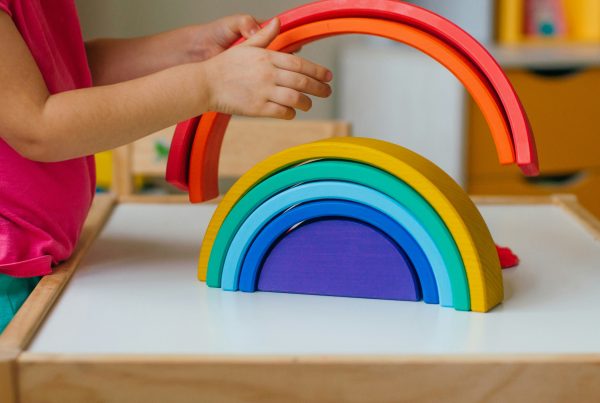
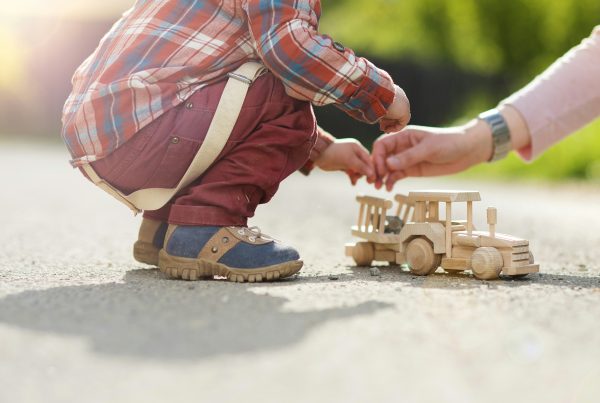
Playthings that allow for 100% open-ended creation (or no single “right” answer) are huge for learning to keep trying in the face of frustration. Magna-tiles, wooden blocks, LEGO: A tower comes crashing down? That’s not failure, it’s an invitation to redesign. Puzzles with a high complexity level (keep in mind your child’s age/developmental level) can help develop frustration tolerance and self-propelled perseverance, with the accompanying sense of self-accomplishment that comes with it.
The Play: Be careful not to jump in and show them how to do something if they are struggling. Try a few kind statements about the process: “You’re working so hard to make that foundation strong!” rather than “Wow you made a cool building!”
4. Empathy (recognizing and relating to the emotions of others)
Toy Tool: Dollhouses & Community Play Sets
A dollhouse set up with figurines of people with a range of ages, abilities, and ethnicities. This sets the scene for practicing perspective-taking and empathy.
Narrate scenarios that involve reading other people’s feelings and resolving social conflicts. “Little sister is crying because big brother took her toy! How can he make it better? How do you think she feels?”
5. Social Skills (building relationships)
Toy Tool: Cooperative Board Games
Swap the “everyone for themselves” model of traditional games for games in which all players are on the same team and play against the game. Hoot Owl Hoot!, Race to the Treasure!, and The Fairy Game are all great options in which players are encouraged to share ideas, make joint decisions, and collaborate to win the game. In these games, players learn to share the emotional high of a win.
The Play: Demonstrate sportsmanship and narrate your child’s thought processes as they play. “Oh man, we’re really in a tight spot now! Should we use Sarah’s idea or Jamal’s idea to make the fairy get home?”
EQ-Building Toys for Every Gender
A boy holding a doll is not automatically headed for a career in nursing or social work. He is in the process of learning to nurture and take care of others, a key piece of empathy. A girl playing with a complex marble run is not showing a sign that she will be better at math or engineering in the future. She is learning resilience through trial and error, problem-solving through experimentation.
All children need access to all kinds of EQ-building toys, no matter their gender. By giving all toys to all kids, we allow them to develop a full emotional toolbox.
The EQ Play Guide: Your Role as the Adult
As always, you are the most important toy in the room. When it comes to play, we want to offer two skills to be your emotional intelligence guide:
Observe and Narrate: “I notice that you are squeezing that stress ball really hard. I bet you must be feeling a lot of big energy inside.”
Label Emotions in Play: “Look at that dinosaur! He is roaring SO LOUDLY. I bet he must be really, really angry that his friend won’t share his swamp with him.”
Follow Their Lead: If your child wants to engage you in their play, that’s great. Otherwise, let the child lead the play and you support it by providing verbal scaffolding for their emotional development.
Building Your EQ Play Box
Pick at least one toy for each of the 5 parts of EQ. Make sure to have things for self-regulation (sensory toys), emotional expression (art supplies, dress up clothes), cooperation, competition, and decision making (board games, building sets), and props to encourage relationship-based storytelling (figurines, dolls).
Turns out play is the universal language of emotions, and toys the tools to learning to speak it. With those tools, kids learn not only how to navigate their inner world, but also how to connect with others in a deep, healthy, and meaningful way. It’s the most important work they will ever do—and they can start today with the toys you pick.